How To Model Language For Your Toddler
Less Quizzing and More Connection!
From a Speech-Language Pathologist
This post contains affiliate links. Play and Say, LLC may earn a small commission at no additional cost to you. We only recommend products we genuinely use, love, or would confidently recommend to families!
“Who’s this?!”
“What color is this?!”
“What sound does it make?!”
These might be some of the questions you ask your toddler during play. As a speech-language pathologist, I completely understand how hard it can be not to! We naturally ask questions because we want to engage with our children and encourage them to communicate with us.
But when we ask question after question during play, it can start to feel more like a quiz instead of an opportunity to connect (and who likes being quizzed?!). More importantly, too many questions can mean fewer opportunities for you to model the language your toddler can understand and eventually imitate.
Instead of constantly asking your child to show you what they know, comment, model, and follow their lead during play instead. You may be surprised by how many more opportunities for communication naturally happen as you have FUN together!
So how do we model for our kids??
During play, model what you want your child to say whether it’s an animal sound (“ruff!”), name of a toy (“ball!”), or an action (“go!”). Be consistent and repetitive! We know that toddlers looooove to do the same thing 20 times in a row - that gives you 20 times to model that same word or sound! Pause each time to allow your child to attempt it themselves but don’t pressure them to verbally respond. Modeling in this way will provide your child with a safe space to try themselves!
Here’s a perfect example…
One toy I love for toddlers (both in speech therapy and in my own home) is a farm animal and barn set.
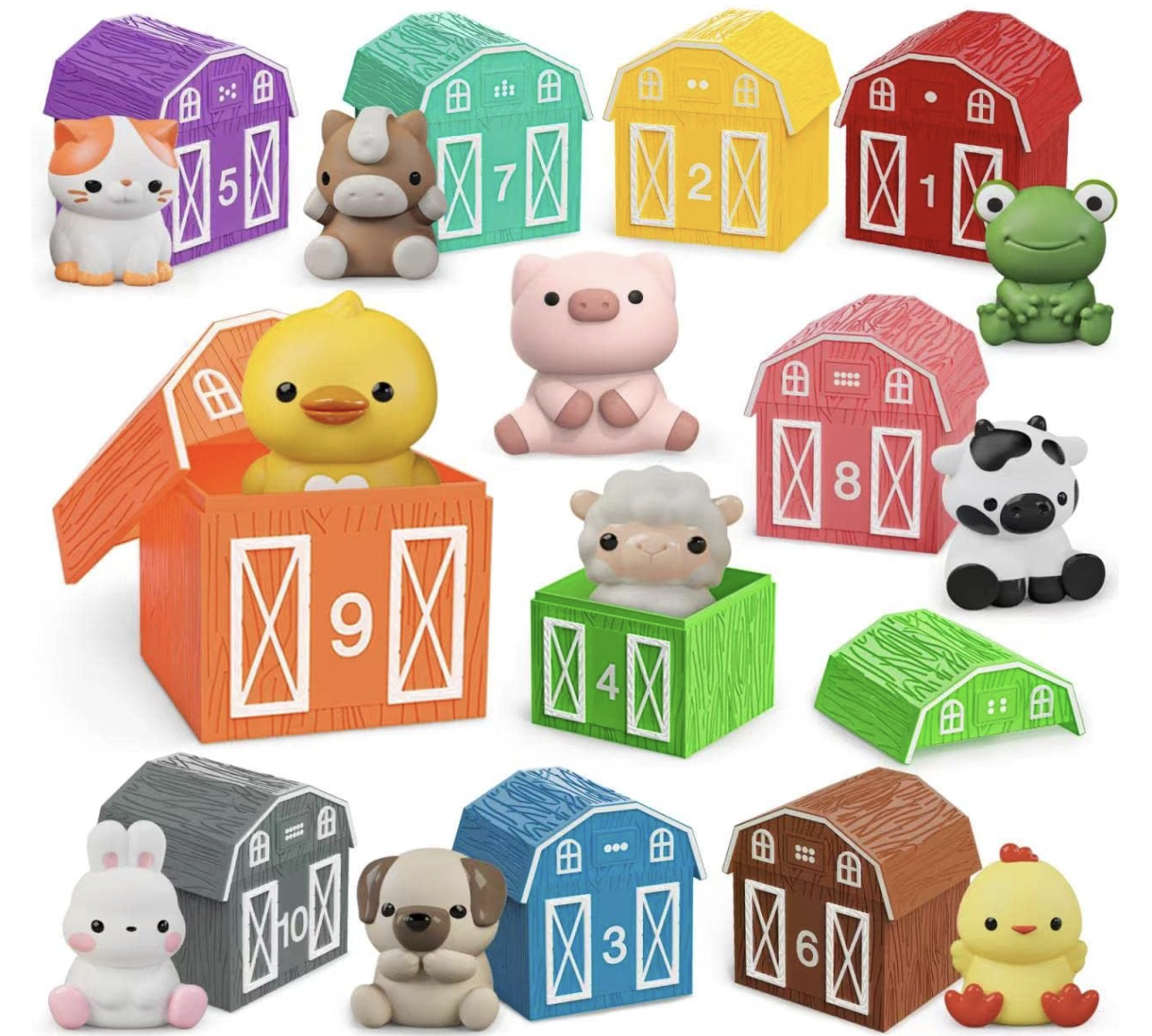
You can use a toy like this in so many different ways, which is exactly why I love open-ended toys for language development!
First, you can keep it simple by holding up each animal and modeling its name (“cow!”). You can also model the animal sound (“mooooo!”).
Then, follow your child’s lead and build language into whatever they’re already interested in doing. Knock on the barn and model “open!” each time you open the door. Say “hi!” as you take an animal out and “bye-bye!” as you put it back inside. If the animal falls, you might say “uh-oh!” or “down!”. Model “in!” and “out” as you and your child put the animals in and take them out.
Once your child is using a single word, add another word to it to encourage them to start putting words together into short phrases!
“Hi cow!”
“Cow in!”
“Go cow”
Use your imagination; make the animals eat, sleep, jump, run, hide, crash, or go for a ride. These open-ended toys create endless opportunities for play, connection, and language!
Modeling early language is just one of the topics that I cover in my 1:1 coaching sessions, where I work to provide information and practical strategies that can be easily incorporated into your child’s daily life, play, and routines.
My goal is to help caregivers feel confident supporting their child’s communication without adding more to their already busy day.
Small changes in the way we interact with our children can create meaningful opportunities for communication. Supporting language development isn’t just something that happens during speech therapy. It happens during snack time, in the car, while getting dressed, at the park, and most importantly, through connection and play.